The call usually comes at a bad time. Mom fell. Dad's in an ambulance. Someone at the hospital is about to ask you what medications your parent takes, who their doctor is, and who's allowed to make decisions. Nobody wants to answer those questions from memory in a waiting room.
I've been there. I was 600 miles away when my dad fell. The hospital asked what he was taking, and I didn't know. We had the information; it was in four places.
This checklist is for adult children of aging parents who want to make sure that doesn't happen to their family. It isn't medical advice. For anything about symptoms, treatment, or medications, your parent's clinician or pharmacist is the right person to ask. This is the organizing part: what to gather, what to pack, and how to keep everyone on the same page.
The short version
If you're heading to the ER right now, grab these five things:
- Your parent's medication list (or the bottles themselves)
- Photo ID and insurance cards
- Their allergies
- Names and numbers for their doctors and pharmacy
- A copy of the health care proxy or power of attorney, if they have one
Everything below fills in the details, and it's easiest to prepare before you need it.
What to bring to the ER: the one-page summary
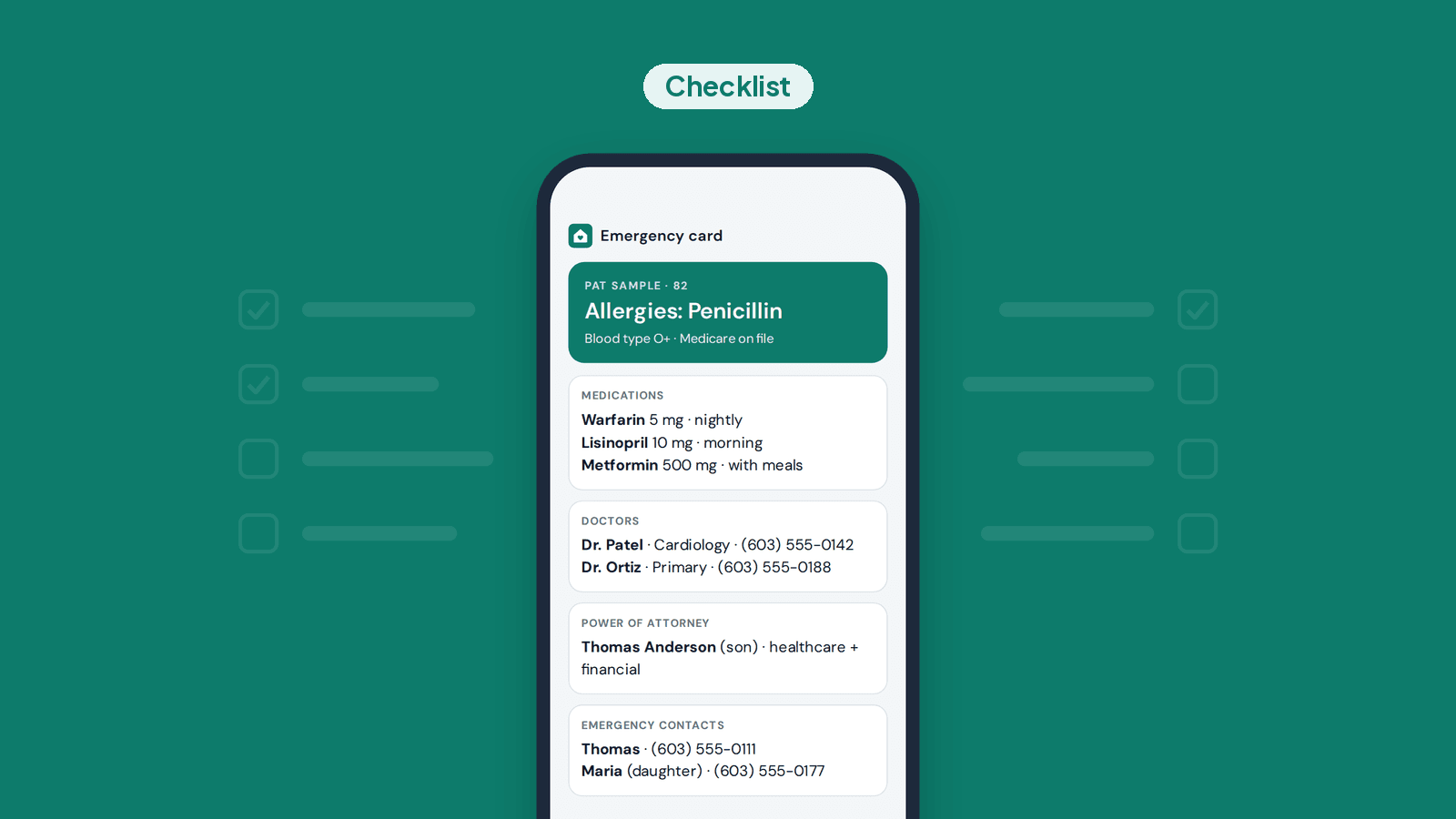
If you only do one thing on this list, make this page. Keep a copy on your phone, one in your parent's wallet, and one where a family member or neighbor can find it.
- Full legal name and date of birth, plus a photo ID
- Insurance cards: photos of the front and back of every card (Medicare, supplemental or Medicare Advantage, Medicaid, prescription plan)
- Current medication list: each medication's name and dose, copied exactly from the label (don't guess), plus the prescribing doctor and the pharmacy. Include vitamins and over-the-counter products your parent takes regularly.
- Allergies: medications, foods, latex, and anything else, as their doctor has recorded them
- Diagnoses and history, in their doctor's words: ongoing conditions, past surgeries, recent hospital stays, and any implanted devices (such as a pacemaker)
- Doctors and pharmacy: primary care doctor, key specialists, and the pharmacy, each with a phone number
- Emergency contacts: two or three people, with phone numbers and their relationship to your parent
- Who can make decisions: the name of the health care proxy or power of attorney (POA) holder, and where the documents are
- Their "normal": a line or two about how your parent usually is (walks with a cane, hard of hearing, sharp in the morning but more confused at night). ER staff don't know your parent, and this helps them see what's changed.
If you're not sure what's on the list, ask your parent's pharmacist for a printout of their current prescriptions. It's a good starting point, and you can fill in the rest from there.
Documents to bring to the hospital
You don't need originals in the ER, but you do need to be able to find them fast.
- Health care proxy or medical power of attorney: a copy, or a photo of the signed pages
- Advance directive or living will, if your parent has one
- Any out-of-hospital orders your parent's doctor has signed (some states call them POLST or MOLST forms)
- Permission to share information: if your parent has signed a form letting their doctors talk with you, know where it is. Their doctor's office can tell you which form they use.
Copies of all of these should be somewhere the whole family can get to. A folder in one person's desk drawer doesn't count if that person is on a plane.
Hospital go-bag checklist
Hospital visits almost always run longer than you expect. A small bag by the door (or in your trunk) saves a lot of scrambling.
For your parent
- Glasses, hearing aids (plus spare batteries or the charger), and dentures with a case
- Phone and a long charging cable, since outlets are rarely near the bed
- A change of clothes, socks with grips, and a sweater (ERs are cold)
- Their medication bottles, or clear photos of every label if you can't grab the bottles
- A printed copy of the one-page summary above
For you
- Your own phone charger
- A notebook and pen, or a notes app you'll actually use
- Water, a snack, and anything you need to get through several hours
- A paper list of key phone numbers, in case a phone dies
How to advocate for your parent in the ER
The ER moves fast and information comes at you in pieces. A few habits help.
- Pick one point person. One family member talks with the care team and relays updates. Staff appreciate it, and it keeps stories from drifting.
- Write things down as they happen. Names of the doctors and nurses, tests that were ordered, what you were told, and the time.
- Hand over the summary early. Give the printed page to the intake nurse. It saves your parent from answering the same questions again and again.
- Ask about admission status. If your parent stays, ask whether they've been formally admitted or are being kept "under observation." The difference can affect what insurance covers, and the hospital's case manager can explain what it means for your parent.
- Ask who to call with questions later. Get a name and number before you leave.
Keeping the family updated
This is where a lot of families get stuck. The sibling in the room is overwhelmed, and everyone else is texting for news.
- Use one channel. One group thread or one shared place for updates, instead of five separate conversations.
- Set an update rhythm. "I'll post an update every two hours, or sooner if something changes" cuts down on the "any news?" texts.
- Split the jobs. Someone handles the pets, someone calls the neighbor, someone checks the mail. Write down who's doing what so nothing falls through.
- Stick to what the care team said. Pass along what you were told, and let the doctors do the explaining.
After the ER visit: discharge papers and medication changes
Coming home is when details slip. Before you leave, and in the first few days after:
- Read the discharge paperwork and keep a copy with everything else
- Update the medication list with any new, changed, or stopped medications, exactly as the discharge instructions say. If anything is unclear, ask the pharmacist or the discharging doctor, not the group text.
- Book the follow-up appointments and put them on a calendar the family can see
- Tell the primary care doctor's office about the ER visit if the hospital didn't
- Refresh the one-page summary so it's ready for next time
Where ParentCareHQ fits
You can do all of this with paper and a shared folder, and plenty of families do. We built ParentCareHQ to keep it in one place your whole family can reach from anywhere. The Emergency Card pulls your parent's allergies, emergency contacts, primary doctor, and power of attorney onto one screen. The medication list can be printed or shared, and legal documents, providers, and a shared calendar all live alongside it. Family members join free.
Have questions about how it works? The FAQ covers setup and sharing, and pricing is simple: 14 days free, no credit card.
Whatever you use, the best time to build the list is on a quiet Tuesday, not in the ER. Start with the one-page summary tonight. Five minutes is enough to get the most important parts down.